

10 Proven B2B Digital Marketing Strategies That Drive Real Results

Companies that systematically research their prospects and clients grow three to ten times faster and become twice as profitable than those that don’t . These numbers show what effective B2B digital marketing strategies can do for your business.
The digital world has become fiercely competitive, and lead generation alone won’t cut it anymore. Successful B2B digital marketing strategies must build trust and showcase clear value. Research shows that 80% of potential clients visit your website while evaluating service providers . More than 60% check out your social media presence before making their final call . These numbers prove why B2B digital marketing strategies need to work now more than ever.
This piece shares battle-tested B2B marketing strategies with measurable outcomes. Real companies have used these practical approaches to achieve 8-10x higher sales and generate 57% of non-direct revenue . Your business might need a complete marketing overhaul or just a boost in specific channels. Either way, these ten strategies will help you accelerate real business growth in 2026 and beyond.
Research-Driven Marketing
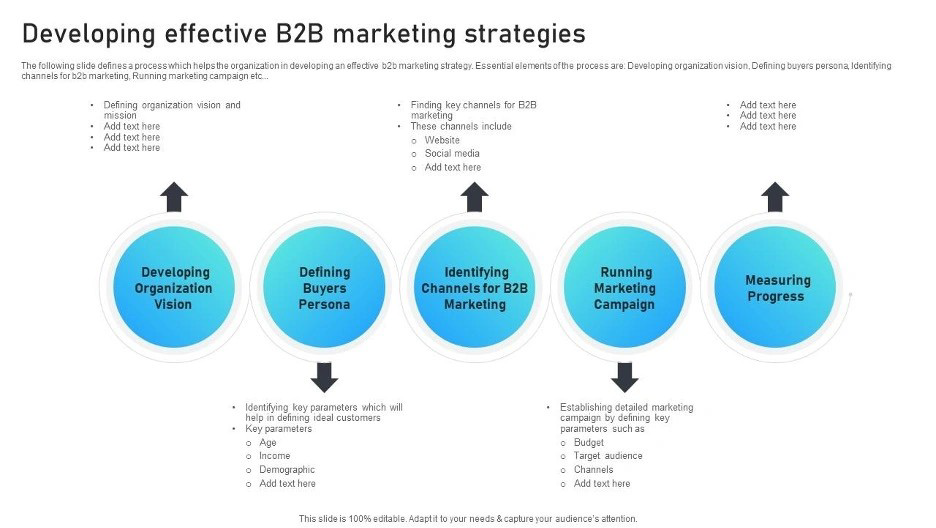
Image Source: Incisive Edge
B2B marketers who use data are three times more likely to see major improvements in their decision-making [1]. This stark contrast shows why research-driven marketing has become essential for companies aiming for green growth in 2026.
Research-Driven Marketing
Research-driven marketing removes guesswork by using customer data, market insights, and analytics to shape every strategy aspect. This approach uses factual information to guide decision-making and campaign development instead of relying on assumptions.
Strategy Overview
Research-driven marketing gathers feedback and data from business professionals systematically to understand how organizations think, buy, and choose partners. The approach collects relevant information from multiple sources:
- Customer interactions and behavior patterns
- Market trends and competitive positioning
- Website analytics and engagement metrics
- Social media performance and sentiment
- Sales data and conversion pathways
Creating a complete picture of your target audience’s needs, priorities, and pain points is the main goal. This enables precise targeting and messaging that strikes a chord with decision-makers.
Why Research-Driven Marketing Works
Data-driven marketing surpasses traditional approaches by addressing actual customer needs rather than perceived ones. Strategy refinement—not increased budgets—drives improvement in 74% of marketing campaigns [2].
Businesses that heavily rely on data are three times more likely to report major improvements in decision-making [1]. McKinsey research shows data-driven sales in B2B can boost profits by 15-25% [1].
The success comes from its power to deliver:
- Accurate customer understanding that drives personalization
- Objective measurement of campaign performance
- Clear insights for continuous optimization
How to Implement Research-Driven Marketing
A structured approach helps implement research-driven marketing:
Start by creating a clean, centralized database that unites information from various touchpoints—CRM systems, marketing automation platforms, website analytics, and customer interactions.
Next, analyze buyer behavior by mapping how prospects research, compare, and confirm vendors [3]. This reveals the true drivers of decisions at each stage of their experience.
Then, segment your audience using specific criteria beyond simple demographics. Understanding their unique pain points, priorities, and decision-making factors helps deliver targeted messaging.
Lastly, measure everything using multi-touch attribution to understand how each channel contributes to conversions [3]. Clear KPIs that match your business goals help continuously refine your strategy based on performance data.
Note that technology alone isn’t enough—61% of marketers achieve better results through strategy refinement [2]. Successful B2B marketing strategies combine powerful tools with human expertise to turn data into meaningful action.
Niche-Focused Positioning
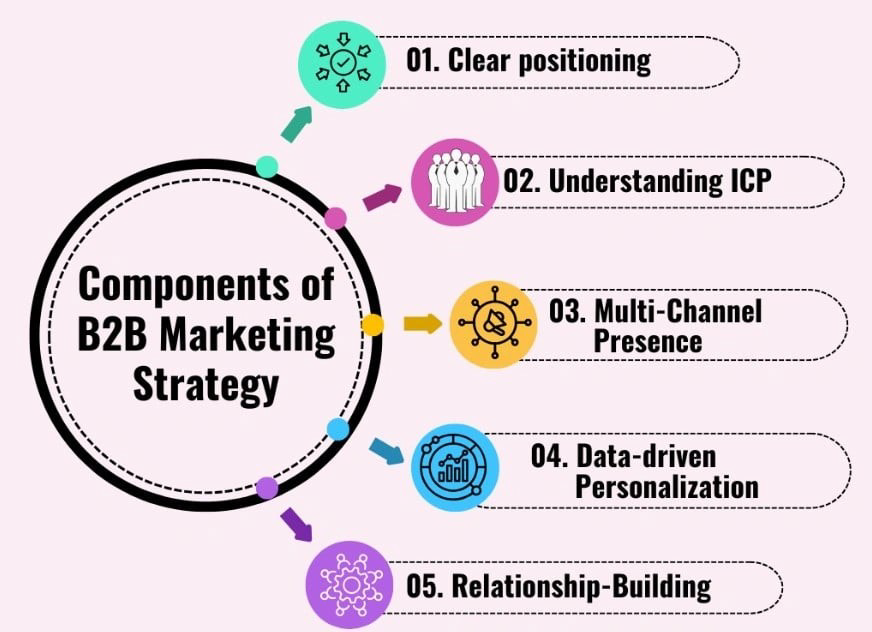
Image Source: Agility PR Solutions
B2B decision-makers actively seek suppliers with niche expertise – more than half of them. This makes specialized knowledge essential in today’s B2B digital world [4]. These numbers highlight why niche-focused positioning has become a leading B2B digital marketing strategy for companies that want to stand out in crowded markets.
Niche-Focused Positioning
Strategy Overview
Niche-focused positioning targets a specialized market segment instead of trying to appeal to everyone. Your marketing efforts concentrate on a defined audience with specific needs, challenges, and priorities. You become “the big fish in a small pond” [5] by creating tailored solutions for a highly specific customer group.
Broad-market approaches dilute your message, but niche positioning lets you address your target audience’s unique pain points directly. A manufacturing company might focus solely on precision components for the aerospace industry. This approach tackles specific needs like regulatory compliance and safety standards [6].
Why Niche-Focused Positioning Works
Niche positioning yields exceptional results because it eliminates the “one-size-fits-all” approach that doesn’t work well in B2B marketing. The benefits stand out:
- Reduced competition: A specific niche means fewer direct competitors and creates your unique market space [1]
- Premium pricing: Your specialized expertise commands higher rates as clients value your deep knowledge [7]
- Stronger customer loyalty: B2B customers expect companies to understand their unique needs – 73% of them [4]
- Higher ROI: Targeted marketing resources produce better returns [5]
- Word-of-mouth growth: Referrals spread faster within tight-nit niche communities [5]
These benefits create measurable business outcomes. Companies with a niche focus create more client value over time at lower costs [1]. They build stronger brand reputations through expertise and deeper customer relationships.
How to Implement Niche-Focused Positioning
A methodical approach helps implement effective niche positioning:
Start with market research to find underserved segments in your industry [6]. Look for gaps where current solutions don’t address specific pain points or challenges.
Your chosen niche needs deep expertise development. B2B buyers say vendors don’t understand their business well – 56% agree [4]. Real authority in your specialty creates immediate differentiation.
Your audience’s language should shape your messaging. Use industry-specific terms, relevant case studies, and highlight your solution’s fit with niche challenges [4]. Show that you understand your clients’ business context through your marketing.
Creating hyper-specific content addresses niche pain points, regulations, terminology, and role-based concerns [4]. This builds trust and establishes your brand as the go-to solution.
Successful B2B digital marketing strategies need continuous refinement based on customer feedback. This helps you keep up with trends in evolving niche needs [5].
High-Performance Website

Image Source: Atlanta Web Design Company | Trajectory
B2B marketplace statistics show that 54% of search users click on the first three organic search results [8]. This trend makes high-performance websites crucial assets for companies aiming to stay ahead of competitors.
High-Performance Website
Strategy Overview
Your high-performance website acts as a digital storefront that works round the clock to connect with prospects [8]. These websites go beyond simple informational sites by combining technical excellence, user-focused design, and strategic conversion elements. They generate qualified leads and support the customer’s entire experience.
The core components include:
- Technical foundation: Speed optimization, security protocols, mobile responsiveness
- Strategic information architecture: User-friendly navigation and logical user pathways
- User-focused design: Clean, professional esthetics with clear calls-to-action
- Conversion optimization: Simplified forms, compelling content, and participation tools
Your company’s most powerful marketing asset [9] does more than inform visitors—it guides them through a purposeful experience to become qualified leads.
Why a High-Performance Website Works
Evidence supporting high-performance websites proves compelling. B2B buying cycles take longer than B2C, yet both need exceptional digital experiences [8]. Small improvements in conversion rates can create substantial financial benefits.
These statistics tell the story:
- Sites loading within 1 second achieve conversion rates three times higher than those taking 5 seconds [10]
- Mobile loading speed improvements of 0.1 seconds can boost conversions by 8-10% [10]
- Simple forms can increase conversion rates from 0.96% to 8.1% [11]
On top of that, 53% of mobile users leave sites that take more than 3 seconds to load [10]. Technical performance clearly affects business outcomes.
High-performance websites build credibility effectively—crucial in B2B where substantial financial stakes drive careful vendor evaluation [11]. These sites establish trust and capture valuable leads through strategic content presentation and user-friendly experiences.
How to Implement a High-Performance Website
A high-performance B2B website needs attention in several key areas:
Start with a solid technical foundation. Speed optimization comes through image compression, code minification, and browser caching [8]. Proper security protocols include SSL certificates and regular updates. Your site should respond smoothly across all devices [10].
Good information architecture proves essential. Clear navigation paths should guide visitors based on their needs and buying stage [12]. Logical content organization needs consistent menus and straightforward site structure [10].
Conversion optimization elements make a difference. Compelling calls-to-action use action-oriented language and strategic placement [6]. Multi-step lead generation forms gather information gradually instead of overwhelming prospects with lengthy forms upfront [11].
Evidence-based decision making should guide implementation. Make use of tools like Google Lighthouse to review performance metrics including speed, accessibility, and SEO [8]. Regular A/B testing of copy variations, form designs, and page layouts helps optimize performance [11].
Note that a high-performance website needs continuous maintenance, testing, and optimization based on user behavior and analytics [7].
SEO and Generative Engine Optimization (GEO)
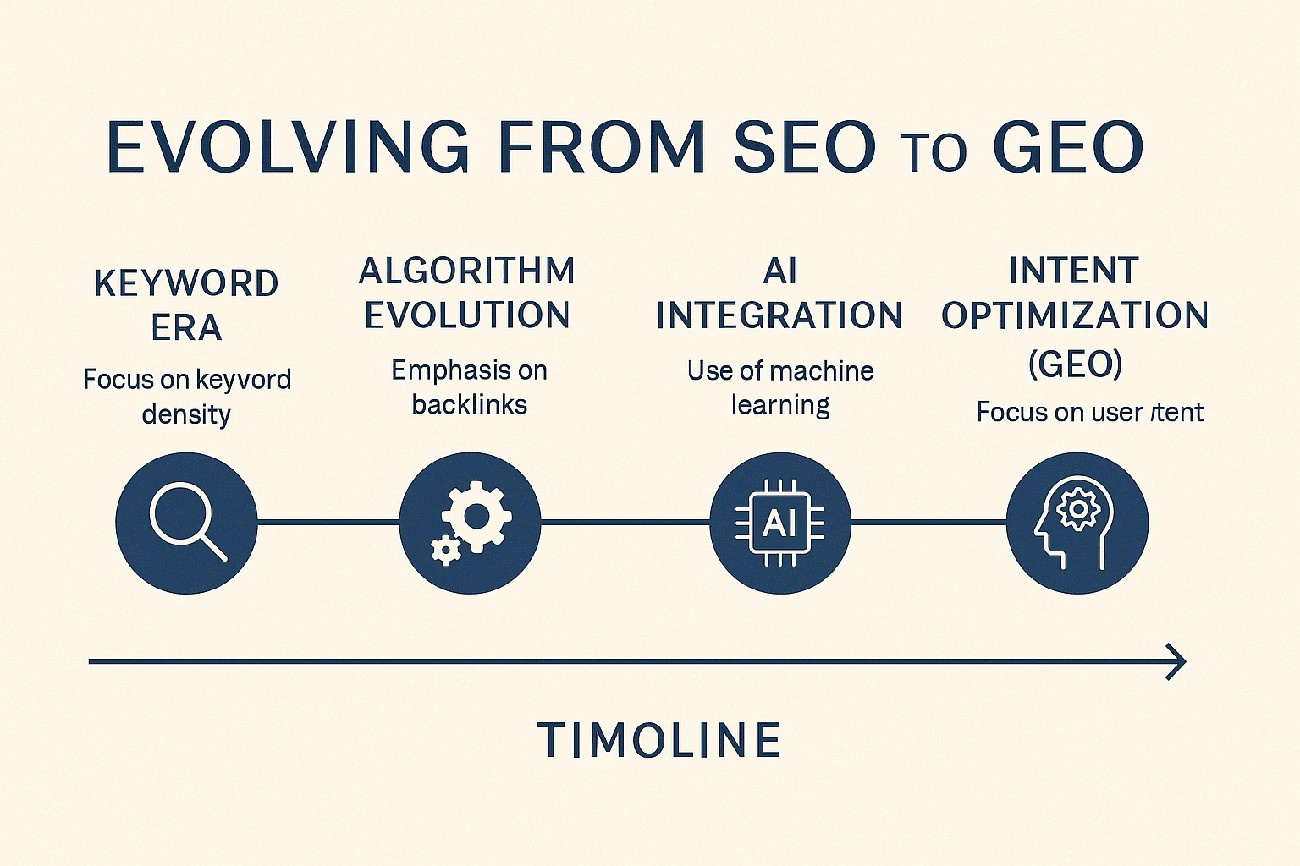
Image Source: Outranking
Google handles about 13.7 billion searches daily, which is more than double Instagram’s 6.5 billion [13]. But a big change is coming. Gartner predicts AI search will cut traditional search traffic by more than 50% [14]. B2B companies need to become skilled at both traditional SEO and the new Generative Engine Optimization (GEO) to stay competitive.
Strategy Overview
SEO and GEO are two different yet complementary ways to boost digital visibility. Traditional SEO helps rank your website in search results through keywords, backlinks, and technical optimization. GEO aims to get your content quoted directly in AI-generated answers from platforms like ChatGPT, Gemini, and Perplexity [15].
These approaches serve different purposes. SEO brings users to your website, while GEO makes sure your expertise shows up in AI-generated responses [16]. B2B buyers now use both channels during their research, making this dual approach essential.
Why SEO & GEO Work
Most B2B buyers will use generative AI tools to research, review, and shortlist vendors by 2026 [15]. AI search platforms might even drive more traffic than traditional search by 2028 [13].
This combined approach works because:
- Visibility across the entire buyer journey: About 60% of searches get no clicks [13], but AI-generated answers can showcase your brand even without website visits
- Authority building: AI platforms that quote your content help build trust with potential clients
- Competitive advantage: Traditional search engine traffic will drop 25% by 2026 [1], so early GEO adoption gives you an edge
How to Implement SEO & GEO
A successful SEO and GEO strategy needs both technical elements and solid content:
Your technical foundation comes first. Use schema markup with JSON-LD to help AI engines grasp your content’s meaning [17]. Set up your robots.txt file to welcome AI crawlers with commands like “User-agent: OAI-SearchBot Allow: /” [17].
Content needs structure for both humans and AI. Add brief TL;DRs at the start of articles to guide AI quotes [17]. Put key information first since AI systems read top to bottom and often stop once they find what they need [17].
Build topic authority through detailed content clusters. Group your content into themes that show your expertise across the site [1].
Show E-E-A-T (Experience, Expertise, Authoritativeness, Trustworthiness) at every level. Author credentials matter more than ever, so include relevant experience and expertise in author bios [13].
The best B2B digital marketing strategies use both traditional search and AI-generated discovery. This approach positions your brand as an authority wherever potential clients look for information.
Social Media Engagement
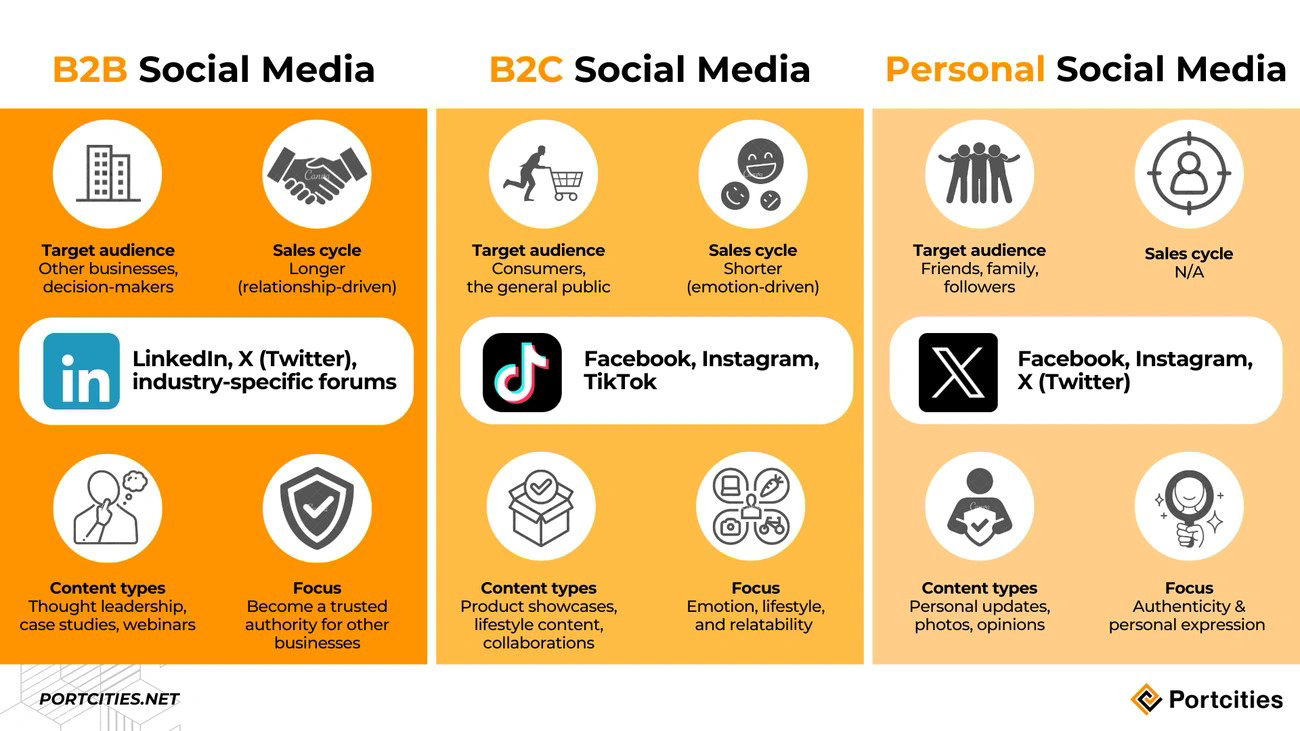
Image Source: Portcities
Social media has evolved beyond a nice-to-have feature. B2B companies now see it as a strategic must-have, with 60% of B2B marketers planning to boost their social media ad spending in 2026 compared to 2024 [5].
Social Media Engagement
Strategy Overview
B2B social media engagement means building meaningful connections with clients on platforms where business leaders spend their time. Your strategy should create content that matches each marketing funnel stage:
- Top of Funnel (TOFU): Content that builds brand awareness and interest, like industry-related posts and trending content adapted to your sector [5]
- Middle of Funnel (MOFU): Educational material for interested buyers who think about purchase decisions, including product features, demos, and case studies [5]
- Bottom of Funnel (BOFU): Content that drives conversion and retention, such as customer appreciation posts and testimonials [5]
The best B2B social engagement strategies line up with broader demand generation and account-based marketing efforts to deliver consistent messages across touchpoints [5].
Why Social Media Engagement Works
Wpromote’s report shows social media as the top B2B channel for revenue generation [4]. Several key factors drive this success:
B2B decision-makers are people first. They connect with social content that strikes a chord on a personal level [5]. Social platforms have become the go-to content distribution channels—LinkedIn (96%), Facebook (76%), and Twitter (70%) lead as the top three organic channels for B2B marketers [4].
Employee advocacy programs deliver amazing results. They generate up to 200% higher click-through rates and 700% more engagement than company-shared content [5]. This expanded reach builds trust, which Edelman calls “the ultimate currency” [5].
Trust shapes buying decisions. B2B buyers who trust a company are almost twice as likely to pay premium prices [5].
How to Implement Social Media Engagement
Here’s how to build a winning B2B social media engagement strategy:
- Set clear, measurable goals for engagement metrics and posting frequency to stay consistent [4]
- Create a 90-day content calendar with input from product, sales, and support teams [18]
- Develop audience-focused content that delivers real value, with emphasis on expertise through industry reports and trend analyzes [5]
- Time your posts well—Tuesday through Thursday work best for engagement [4]
- Set up reliable attribution tracking to link social activities with business results—34.5% of B2B marketers want to prove ROI more effectively in 2026 [5]
Your content should make your audience’s jobs easier by providing solutions or insights [5]. Reviews and testimonials from users serve as powerful social proof that shows potential clients your brand’s reliability [5].
You can tap into the full potential of your top-performing organic content by turning it into targeted ads on LinkedIn and Facebook. These platforms typically give B2B companies their highest engagement returns [5].
Targeted Advertising Campaigns
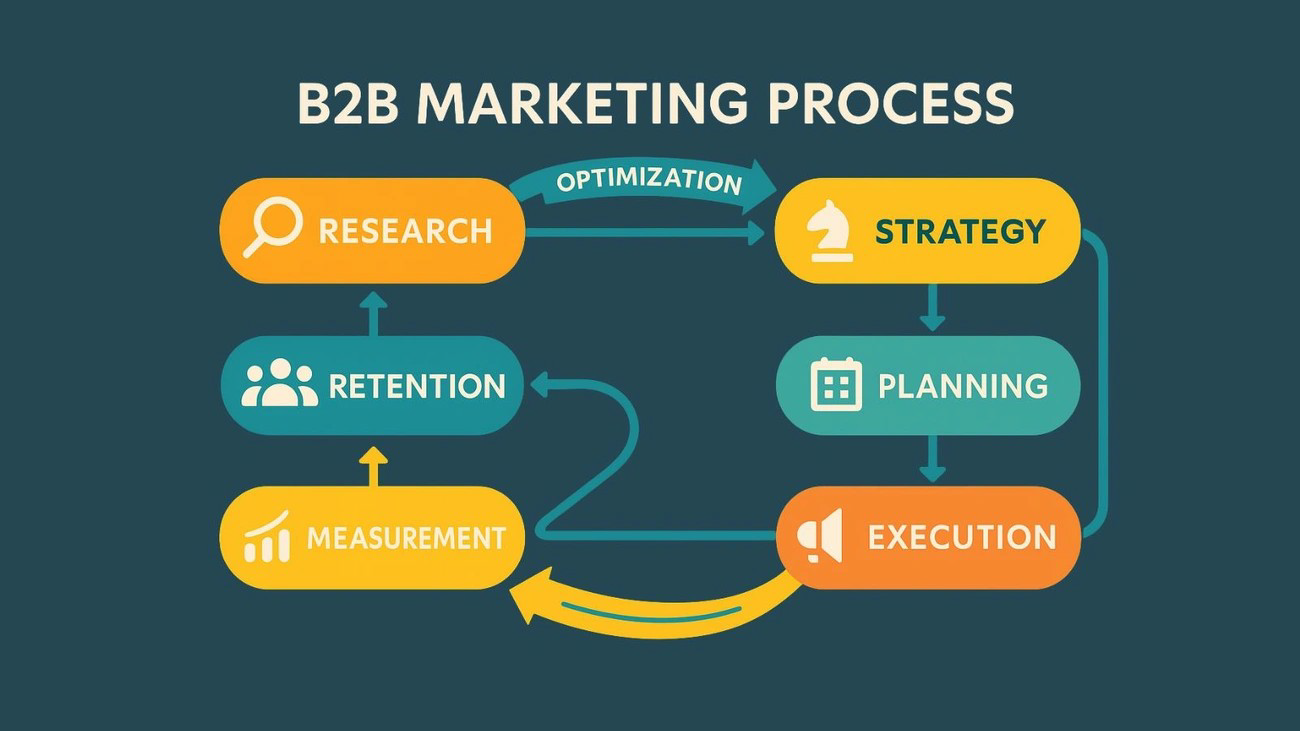
Image Source: The B2B Mix
Personalization has reshaped B2B advertising. About 73% of customers want companies to know their unique needs [19]. This shift has made targeted advertising campaigns crucial for B2B marketers who want real results.
Targeted Advertising Campaigns
Strategy Overview
Targeted advertising sends promotional messages to specific audiences based on their traits, behaviors, and interests [20]. This approach uses precise data signals to reach decision-makers at the right accounts. The timing matches their buying trip perfectly [19].
Common targeting methods include:
- Account-based targeting – Sends ads to specific companies on your target list [9]
- Behavioral targeting – Reaches users based on their online actions and research patterns [21]
- Contextual targeting – Shows ads on websites related to your product or service [21]
- ISP and location targeting – Delivers ads to specific office buildings of prospect companies [9]
LinkedIn stands out as the most effective platform for B2B targeted campaigns. About 93% of B2B businesses say it works best for content distribution [22]. Google Ads and Facebook also deliver strong B2B results, even though Facebook mainly serves consumers [22].
Why Targeted Advertising Works
Targeted advertising beats traditional approaches through precision and relevance. It boosts customer segmentation by splitting your audience into manageable groups with unique traits [11]. This individual-specific experience makes a difference—80% of customers are more likely to buy when they see personalized offers [20].
On top of that, it boosts ROI by focusing resources on high-potential segments [23]. B2B marketers can spend budgets more wisely by showing relevant offers to qualified audiences. This approach leads to higher conversion rates [11].
The data from targeted advertising helps learn about customer priorities and behaviors. These insights help shape future strategies [11]. Quick adjustments become easier, pushing ROI up while keeping costs down [20].
How to Implement Targeted Advertising
Here’s how to make targeted advertising work:
- Pick your target audience carefully—most B2B niches focus on a specific company owner, manager, or executive [6]
- Build a full-funnel strategy that matches different stages of the buyer’s trip—from awareness to consideration to decision [24]
- Utilize audience segmentation tools like Customer Match. These tools help reach known accounts using first-party lists from your CRM [6]
- Run campaigns when your B2B audience is most active through dayparting [9]
- Track measurements and attribution to find your most valuable touchpoints [9]
Brand awareness matters more than sales for B2B lead generation at first [6]. Your ads should bring prospects to your website. They can learn about your solutions and see your expertise there. This approach makes it natural for them to reach out when they’re ready to buy.
Referral and Reputation Marketing
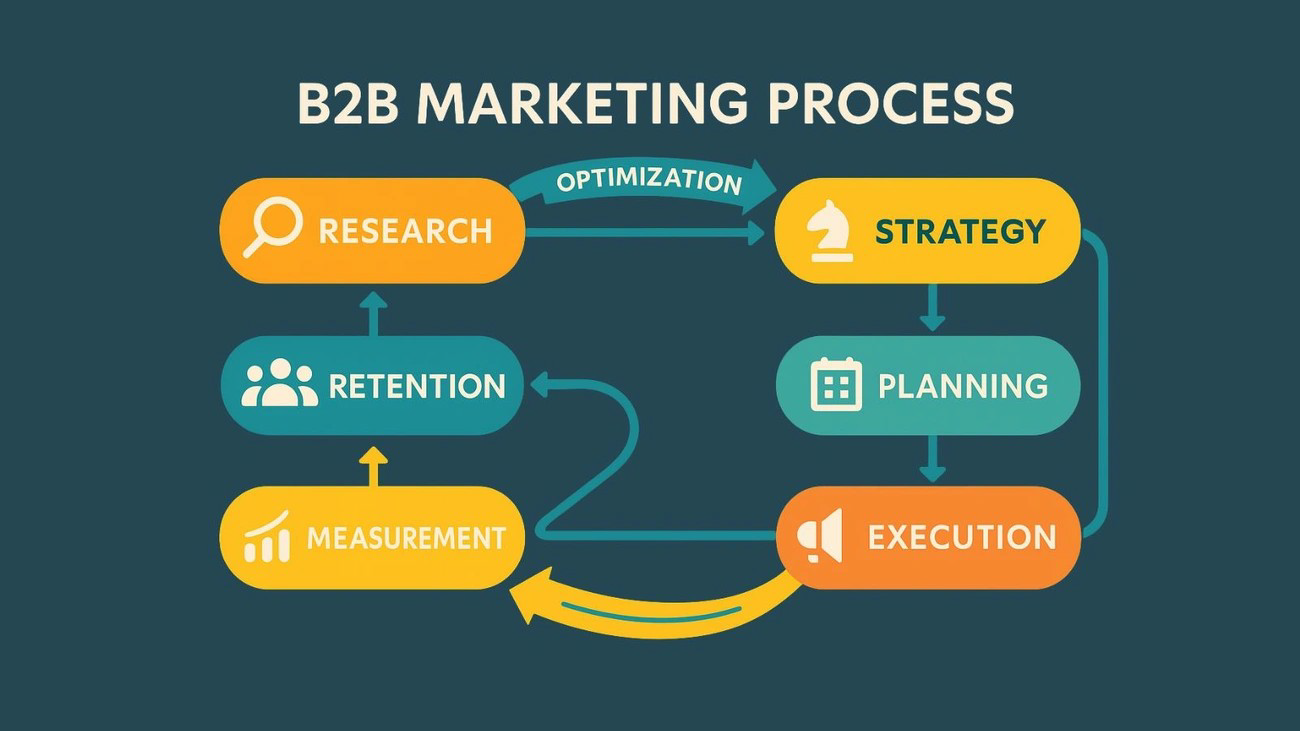
Image Source: The B2B Mix
Harvard Business Review reports that 84% of B2B sales start with a referral [8]. This compelling fact shows why referral and reputation marketing ranks among the best B2B digital marketing strategies to get qualified leads.
Referral and Reputation Marketing
Strategy Overview
Referral marketing gets your happy customers to promote your brand, product, or service to their professional network [10]. A formal referral program creates a well-laid-out system to find advocates, help recommendations flow, and measure results [8]. This method turns natural word-of-mouth into reliable business growth.
The best B2B referral programs need:
- Clear rewards for both referrers and referees
- Simple ways to share that reduce friction
- Reliable tracking systems to measure results
- Links to customer experience (CX) programs
Why Referral Marketing Works
Data strongly confirms that referral marketing delivers results. B2B accounts from referrals are 4x more likely to buy and generate 16% higher lifetime values [8]. These deals also close about 5x faster—20 days compared to 100 days for non-referred leads [8].
Companies that use formal referral programs see 71% higher conversion rates and close deals 69% faster [25]. Success comes from trust—76% of senior managers prefer to work with vendors their contacts recommend [25].
How to Implement Referral Marketing
Here’s how to build an effective B2B referral program:
Start by finding potential referrers through Net Promoter Score (NPS) surveys. Look for promoters (scores 9-10) who will likely recommend you [8].
Create meaningful incentives that busy professionals want. Individual referrers often don’t care about company discounts, so personal rewards work better [26].
Make the referral process simple with clear instructions and templates [10]. Give referrers customizable text they can use to highlight your main benefits [26].
Keep track of important numbers like participation rate, conversion rate, and referral revenue growth [8]. Note that B2B allows for bigger rewards because of higher Annual Contract Values (ACV) [26].
Marketing Automation and CRM Integration
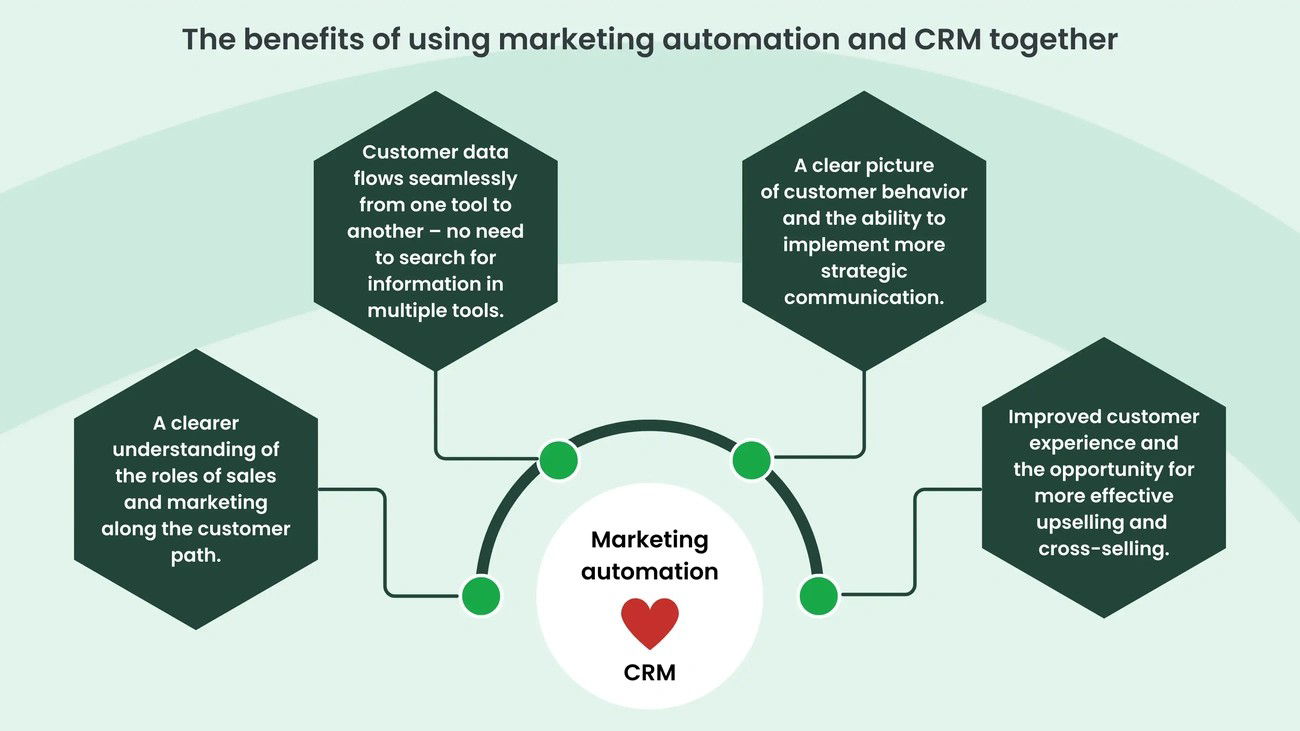
Image Source: Liana Technologies
Companies that use marketing automation see a remarkable 451% increase in qualified leads [7]. This dramatic effect shows why combining marketing automation with CRM systems has become the life-blood of successful B2B companies.
Marketing Automation and CRM Integration
Strategy Overview
Marketing automation and CRM integration connects your customer relationship management system with your marketing automation platform. This combination allows marketing and sales teams to exchange data smoothly [12]. The integration puts all client information in one place, which improves communication and service delivery [27].
This strategy allows you to:
- Track lead behavior and engagement metrics
- Segment audiences with precision
- Deliver customized marketing campaigns
- Measure marketing ROI accurately [27]
Why Marketing Automation Works
Integrated marketing automation has a profound effect on business operations. Companies experience better lead nurturing through automated, customized content delivery when proper integration exists [12]. Marketing automation users generate 77% more conversions [7].
The effectiveness comes from creating harmony between sales and marketing teams [13]. Both departments learn about the complete customer experience as data flows freely between systems [28].
The integration also automates tasks like lead scoring and follow-ups. This saves valuable time while maintaining consistent communication [12]. Staff morale and productivity metrics improve because of this efficiency [13].
How to Implement Marketing Automation
These steps will help you implement marketing automation with CRM integration:
Your first step should be defining clear objectives—whether for improved lead nurturing, better reporting, or efficient processes [12].
The next step involves auditing your current systems to identify gaps and assess what works versus what doesn’t [12].
You should then select the right integration approach. Standard integrations work quickly for common setups, while custom solutions give maximum flexibility for complex requirements [12].
The final step requires continuous testing and optimization of your integration. Regular performance reviews help your automation processes stay in line with changing business goals [17].
A/B Testing and Optimization
Image Source: The B2B Mix
Research from Harvard Business Review shows that companies using controlled experiments consistently make better product decisions. This explains why A/B testing has become a must-have among top b2b digital marketing strategies in 2026.
A/B Testing and Optimization
Strategy Overview
A/B testing—also known as split testing—compares how two content versions perform to find which one strikes a chord with your audience [29]. The method tests a control (A) version against a variant (B) version using key business metrics. B2B companies can test several elements:
- Website components (copy, images, CTAs)
- Email campaigns (subject lines, content, layouts)
- Landing pages and conversion paths
- Pricing models and product features [1]
Why A/B Testing Works
Evidence-based decisions beat gut feelings every time [1]. B2B companies might have smaller traffic volumes, but systematic testing reveals valuable insights about customer priorities.
The results can be remarkable. A SaaS company boosted trial signups by 15% just by changing their pricing page layout [1]. Small improvements matter in B2B—a 2% better conversion rate could mean millions in extra revenue [1].
Regular testing creates a steady flow of ideas to boost customer experience [29]. Companies that test consistently build an edge over competitors who rely on guesswork [1].
How to Implement A/B Testing
B2B testing works best with these nine steps:
- Measure performance baseline
- Set clear testing goals
- Develop a specific hypothesis
- Identify test targets
- Create A/B versions
- Verify setup
- Execute the test
- Track results
- Apply learnings [29]
B2B brings unique challenges. Focus on testing major changes like different value propositions or significant workflow redesigns [1]. Tests should run longer—usually 4-6 weeks—because of lower traffic volumes in B2B [1].
Your hypothesis should follow this structure: “We believe [change] will cause [impact] for [user segment] because [reasoning]” [1]. The focus should stay on metrics that count: trial-to-paid conversion rate, average contract value, and feature adoption rates [1].
Analytics and Performance Reporting
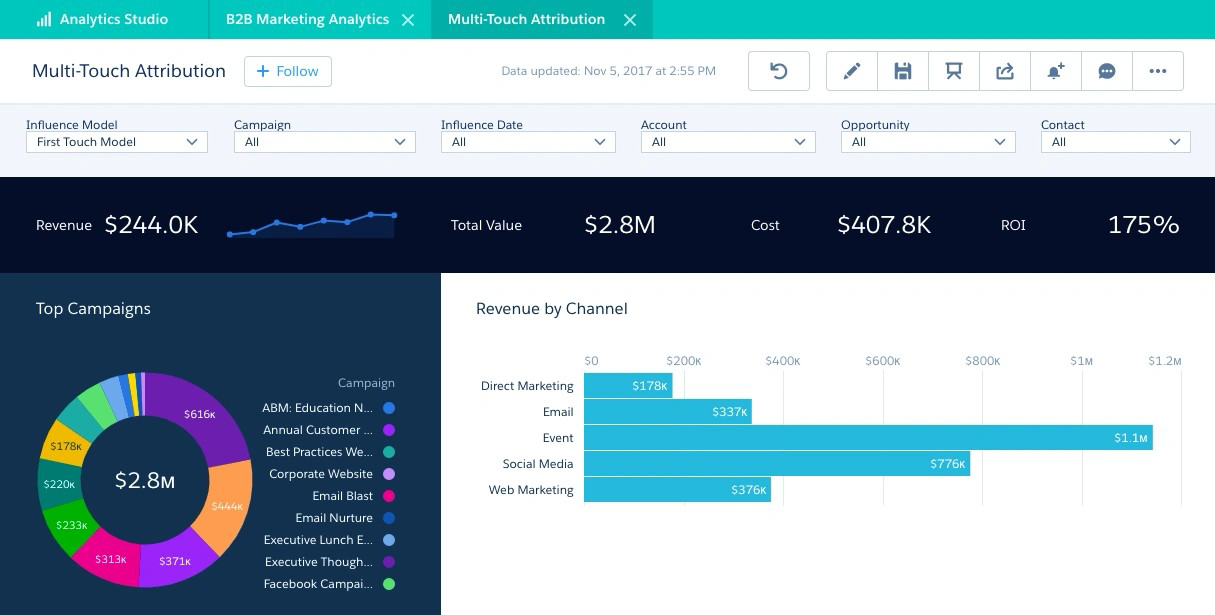
Image Source: Salesforce Ben
Analytics has become the foundation of successful B2B digital marketing strategies, with 89% of leading marketers using performance metrics to measure campaign effectiveness [30].
Analytics and Performance Reporting
Strategy Overview
A systematic framework of analytics and performance reporting helps measure marketing success, track ROI, and make informed decisions. This method collects, analyzes, and visualizes data from multiple sources. The sources include CRM systems, marketing automation platforms, web analytics, and advertising channels [31]. B2B marketers can understand effective strategies, optimize underperforming initiatives, and allocate resources better with these insights.
Why Analytics Matter
B2B marketing cannot ignore the power of analytics. Organizations that utilize data are three times more likely to report better decision-making [32]. McKinsey research shows that data-informed sales in B2B environments can increase profits by 15-25% [32].
Analytics delivers these benefits:
- ROI measurement – Live campaign performance tracking identifies return on investment [16]
- Pipeline visibility – Marketing’s influence on revenue generation becomes measurable [33]
- Resource optimization – Channel evaluation shows which ones bring the highest quality leads [32]
- Predictive insights – Future trends and customer needs become foreseeable [16]
How to Implement Analytics and Reporting
Clear objectives based on business goals form the starting point of effective analytics implementation [34]. The next step creates a clean, centralized database that combines information from various touchpoints [32].
Dashboard visualization presents marketing KPIs through charts, tables, and meters for quick monitoring [35]. These visual tools convert complex data sets into practical insights and speed up decision-making [35].
Success comes from focusing on metrics that truly matter rather than vanity metrics. One simple question helps: “Will this number help me decide?” [36]. Teams should remove metrics that fail this test to avoid data overload.
Comparison Table
| Strategy | Benefits & Results | How to Implement | Success Numbers | Tools You’ll Need |
| Research-Based Marketing | – Makes decisions 3x better
– Boosts profits by 15-25% – Takes out the guesswork |
1. Build your main database
2. Study how buyers behave 3. Group your audience 4. Track everything that matters |
– 74% say better strategy made things work
– 3x more likely to see better results |
– CRM systems
– Marketing automation platforms – Analytics tools |
| Focused Market Position | – Less competition
– Better prices – More loyal customers |
1. Study your market
2. Build expert knowledge 3. Craft your message 4. Make targeted content |
– 73% want their needs understood
– 56% think sellers don’t get their business |
– Market research tools
– Content management systems |
| Fast, Effective Website | – Works round the clock
– Builds trust – Gets more sales |
1. Get the tech right
2. Make it easy to use 3. Add features that convert 4. Let data guide you |
– Sites that load in 1s convert 3x better
– Every 0.1s faster means 8-10% more sales |
– Google Lighthouse
– A/B testing tools – Analytics platforms |
| Search & Maps Strategy | – Shows up in two places
– Builds authority – Beats competitors |
1. Add proper markup
2. Write for AI readers 3. Own your topics 4. Show your expertise |
– Regular search might drop 50%
– 60% of searches stay on Google |
– AI crawlers
– Schema markup tools – Content optimization platforms |
| Social Media Success | – Reaches more people
– Builds more trust – Makes more money |
1. Know what you want
2. Plan your content 3. Share useful stuff 4. Time posts right |
– Gets 200% more clicks
– Staff sharing gets 700% more interest |
– LinkedIn (96% use it)
– Facebook (76% use it) – Twitter (70% use it) |
| Smart Ad Targeting | – Speaks to each person
– Better returns – More sales |
1. Know your audience
2. Plan the whole journey 3. Split people into groups 4. Pick the right times |
– 80% more likely to buy
– 73% expect you to know them |
– LinkedIn
– Google Ads |
| Word-of-Mouth Growth | – Deals close faster
– Customers stay longer – More people buy |
1. Find people who’ll refer
2. Give good rewards 3. Make referring easy 4. Watch what works |
– 84% of B2B starts with referrals
– 4x more likely to buy – Worth 16% more long-term |
– NPS surveys
– Referral tracking systems – CRM integration |
| Smart Marketing Tools | – Better lead growth
– Clearer messages – Better service |
1. Set clear goals
2. Check your tools 3. Pick how to connect them 4. Test what works |
– 451% more good leads
– 77% more sales |
– CRM systems
– Marketing automation platforms – Integration tools |
| Testing What Works | – Facts guide choices
– Always getting better – Stays ahead |
1. Know where you start
2. Pick your targets 3. Make your guess 4. Try and track |
– 15% more people try it
– 2% better can mean millions more |
– Split testing tools
– Analytics platforms – Tracking software |
| Numbers & Reports | – Smarter choices
– More profit – Better use of money |
1. Set your goals
2. Build your database 3. Make easy reports 4. Track what matters |
– 3x better at deciding
– 15-25% more profit |
– CRM systems
– Analytics platforms – Visualization tools |
Conclusion
These ten B2B digital marketing strategies are the foundations of successful modern marketing programs that deliver measurable results. They work together in a collaborative effort to build trust, show value, and get qualified leads.
Research shows companies using data-backed marketing grow three to ten times faster than their competitors. Companies that focus on niche positioning become trusted authorities. This allows them to charge premium prices and build stronger customer relationships.
Your website works as your 24/7 digital storefront. Making it perform better creates an immediate edge over competitors. Learning both traditional SEO and emerging GEO helps you stay visible on all channels where B2B buyers do their research.
Social media has grown from a optional tool into a must-have strategy. Most B2B marketers plan to increase their spending here. Targeted advertising enhances these efforts by sending individual-specific messages to decision-makers at the right time.
Referral marketing is one of the most powerful strategies – 84% of B2B sales start with a recommendation. Marketing automation makes this even more effective. Users who automate get 77% more conversions through efficient processes.
A/B testing gives you a scientific way to keep improving all these elements. Robust analytics link marketing activities directly to business results.
Successful B2B companies know that these strategies need steadfast dedication and constant improvement. The initial phase might be challenging. However, systematically applying these proven approaches creates lasting growth and profitability.
Start with strategies that address your current business challenges. Then methodically build your marketing capabilities. Note that small improvements add up over time. This changes your marketing from a cost center into a predictable revenue generator.
Key Takeaways
These proven B2B digital marketing strategies transform marketing from guesswork into a predictable revenue generator through data-driven approaches and systematic implementation.
- Research-driven marketing eliminates assumptions: Companies using systematic customer research grow 3-10x faster and achieve 15-25% higher profits than competitors relying on guesswork.
- Niche positioning creates premium opportunities: Focusing on specialized market segments reduces competition, enables premium pricing, and builds stronger customer loyalty with 73% of buyers expecting tailored solutions.
- High-performance websites drive conversions: Websites loading in 1 second achieve 3x higher conversion rates, making technical optimization and user experience critical for B2B success.
- Dual SEO and GEO strategy ensures future visibility: With 50% of traditional search traffic declining due to AI, optimizing for both search engines and generative AI platforms maintains competitive advantage.
- Referral marketing delivers exceptional ROI: 84% of B2B sales begin with referrals, with referred accounts 4x more likely to purchase and delivering 16% higher lifetime values.
The most successful B2B companies implement these strategies systematically, starting with their biggest challenges and expanding methodically. Each improvement compounds over time, creating sustainable competitive advantages that transform marketing into a predictable growth engine rather than an expense center.
FAQs
Q1. What are the most effective B2B digital marketing strategies for 2026?
The most effective B2B digital marketing strategies for 2026 include
research-driven marketing, niche-focused positioning, high-performance websites, SEO and Generative Engine Optimization (GEO), social media engagement, targeted advertising campaigns, referral marketing, marketing automation with CRM integration, A/B testing, and analytics-based performance reporting.
Q2. How can B2B companies improve their website performance?
B2B companies can improve website performance by optimizing speed through techniques like image compression and code minification, ensuring mobile responsiveness, implementing intuitive navigation, and incorporating strategic conversion elements like compelling calls-to-action and streamlined forms.
Q3. Why is referral marketing particularly important for B2B businesses?
Referral marketing is crucial for B2B businesses because 84% of B2B sales begin with a referral. Referred accounts are 4 times more likely to purchase, close deals 5 times faster, and deliver 16% higher lifetime values compared to non-referred opportunities.
Q4. What role does social media play in B2B marketing?
Social media plays a significant role in B2B marketing by fostering meaningful interactions with potential and existing clients. It serves as a primary content distribution channel, with platforms like LinkedIn, Facebook, and Twitter being the top organic channels used by B2B marketers to drive revenue and build trust.
Q5. How can B2B marketers leverage data and analytics effectively?
B2B marketers can leverage data and analytics effectively by establishing a centralized database that consolidates information from various touchpoints, defining clear objectives based on business goals, visualizing data through dashboards, and focusing on actionable metrics that drive decision-making rather than vanity metrics.
References
- – https://www.statsig.com/perspectives/ab-testing-b2b-best-practices
- – https://contentmarketinginstitute.com/b2b-research/b2b-content-marketing-trends-research
- – https://www.digitalsilk.com/digital-trends/b2b-marketing-strategies/
- – https://www.goldcast.io/blog-post/social-media-engagement
- – https://blog.hootsuite.com/b2b-social-media/
- – https://ermarketing.net/navigate-the-channel/best-practices-for-google-ads-b2b-targeting/
- – https://encharge.io/b2b-marketing-automation/
- – https://customergauge.com/blog/b2b-referral-marketing
- – https://www.stackadapt.com/resources/blog/b2b-audience-targeting
- – https://demandscience.com/resources/blog/b2b-referral-marketing-strategies/
- – https://www.zinfi.com/glossary/what-is-targeted-marketing/
- – https://marketingguys.com/blog/crm-integration-with-marketing-automation/
- – https://www.paradigmmarketinganddesign.com/the-10-benefits-of-integrating-your-crm-with-b2b-marketing-automation/
- – https://www.expertise.ai/blog/generative-engine-optimization-for-b2b-saas
- – https://www.unrealdigitalgroup.com/generative-engine-optimization-geo-b2b-marketing
- – https://www.thynkbrew.com/b2b-marketing/introduction/data-driven-decision-making-in-b2b-marketing
- – https://42dm.net/b2b-marketing-automation-the-ultimate-guide-for-enterprise-tech/
- – https://www.salesforce.com/blog/b2b-social-media-marketing/
- – https://bombora.com/core-concepts/how-to-identify-and-engage-your-b2b-target-audience/
- – https://www.leadfeeder.com/blog/targeted-advertising/
- – https://myb2bnetwork.com/blog/ad-targeting-explained-precision-reach/
- – https://leadsbridge.com/blog/b2b-ads/
- – https://www.smartcore-digital.com/en/resources/Blog-page/targeted-vs-non-targeted-advertising-in-b2b-digital-html
- – https://www.interteammarketing.com/blog/qualified-b2b-targeting-with-google-display-ads
- – https://www.deeto.com/blog-post/b2b-referral-marketing-program
- – https://cello.so/complete-guide-to-your-b2b-referral-program/
- – https://www.salesforce.com/in/crm/b2b-crm/
- – https://marketingguys.com/marketing-automation/crm-integration/
- – https://www.oracle.com/in/cx/marketing/what-is-ab-testing/
- – https://www.cognism.com/blog/b2b-marketing-metrics
- – https://www.marqeu.com/marketing-analytics-implementation-guide
- – https://oneflow.com/uk/blog/data-driven-decision-making-in-b2b-marketing/
- – https://improvado.io/blog/b2b-marketing-reporting
- – https://diggrowth.com/blogs/analytics/b2b-marketing-analytics-implementation-guide/
- – https://www.netsuite.com/portal/resource/articles/business-strategy/b2b-marketing-shtml
- – https://easywebinar.com/b2b-business-marketing:-how-analytics-and-reporting-drive-smarter-campaign-decisions/
